Lesson 3: Retrieval in Long-Term Memory
Now that we've seen how we bring information in, let's look at a couple of factors of the human mind related to retrieval, or getting memories back out of storage. There is a lot we could go into here, but we will focus on two issues - explicit/implicit memory and amnesia.
Explicit and Implicit Memory
What is the difference between and explicit and implicit memory task?What is the difference in performance between younger adults and older adults in implicit memory and explicit memory tasks?
Again, let's start with a demonstration. First, make sure you print out the response sheet by clicking HERE. Then start the demo and follow the instructions.

Implicit vs Explicit Memory Tasks
These differ as to the instructions given for the task and what the subject does at retrieval.
- Explicit memory task – participant is aware memory is being tested; retrieval is intentional
- Implicit task – participant is not aware memory is being tested; no intentional retrieval
In the demonstration, the filler task was actually an implicit test of your memory.
By way of another example, let's say we presented participants with a list of words like this:
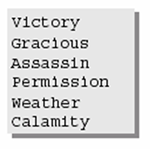
An explicit memory test would be to simply ask people to learn the list and inform them that they would later be tested on the list. Then we'd ask them to recall as many words as they could.
An implicit memory test would be to ask people to learn the list, but without them knowing it was for the purpose of a memory test. Then we might have them complete degraded words, such as the below at the implict test of their memory.

Watch as Dr. Maryellen Hamilton talks about measuring implicit memory and what it is. She also talks about how age affects implicit and explicit memory.
Amnesia
What are the features of the two types of amnesia discussed below?
Amnesia is a cognitive disorder characterized by memory impairments. There are different types of amnesia and there are many underlying causes of amnesia, such as:
|
Traumatic head injury (concussion) Stroke (ischemia) Poisoning Substance abuse Hypoxia (lack of oxygen) Alzheimer's disease Drugs
|
Vitamin deficiency Malnutrition Encephalitis Alcoholism Electroconvulsive therapy (shock therapy) Stress
|
Anterograde Amnesia
First, watch the brief video of Trish who suffers from anterograde amnesia. Which direction does anterograde amnesia flow? What does it spare from before loss? After loss, what can and can't be formed?
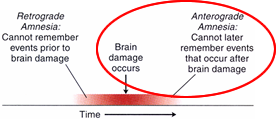
- Forward acting in time from occurrence of damage
- Spares semantic knowledge, episodic memory, and procedural memory from before loss
- Can't form new semantic or episodic memory, but can develop new procedural memory
Retrograde Amnesia
Watch the brief video of Patsy who has retrograde amnesia. Which direction does retrograde amnesia flow? What does it spare from before loss? After loss, what can and can't be formed?
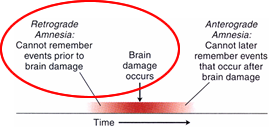
- Backward acting in time from occurrence of damage
- Typically spares "overlearned" semantic and procedural memory, but not always (e.g., Patsy has forgotten how to cook, which would be considered an overlearned skill)
- Can form new memories of all three types - new procedural, semantic, and episodic memory
Implicit Memory of Amnesics
As discussed in your text, people with anterograde amnesia often have zero recall when tested with an explict memory task. However, they do show evidence of implicit memory.
- Implicit memory – occurs when past learning or experience affects current performance without our conscious recollection of it. In other words, we may recall something without consciously remembering it.
The text discusses the work of Warrington and Weiskrantz who gave amnesics and normals tests of the explicit and implicit memory. The graph below summarizes the results discussed in the text. Notice how the amnesics and normals (control) compare on the explicit and the explicit memory task.
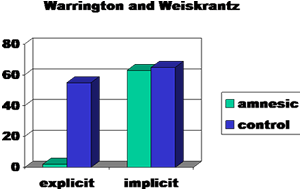
This is very interesting! So while an amnesic cannot directly recall certain information, there is evidence that the memory is actually still there since they perform the same as control subjects on the implicit memory task.
To conclude this section, watch the fascinating video of Clive Wearing. Notice that although he does not consciously remember ever being a musician (he even claims to know nothing about music!), he can still play and conduct which shows his implicit memory of music.
What types of memory has he retained? What can he no longer remember?