Lesson 2: Encoding in Long-Term Memory
The term encoding refers to the way we bring in and process information or events in order to store them in memory. At times, we encode automatically. Think of the TV show or movie you most recently saw. Could you tell me about it? I'm sure you could. But I doubt if you were trying to learn or memorize the plot and characters. However, while watching, you were automatically encoding certain information without effort. That is definitely a part of encoding. However, there are many factors that impact how sucessfully we encode information and events and we will look at some of those next. How we encode information or events matters, because how we encode determines how strong the memory is.
Major questions for this Lesson are:
What is the levels of processing effect? What does it mean to say we can process in a shallow or deep way? Which is better for memory? What factors are responsible for the effect of deep processing?
What is the self-reference effect? Why is this effective? In which brain areas do we see activity for deep and more superficial processing? What is the effect of encoding specificity on memory? What are some examples of this effect?
Levels of Processing
|
|
Fergus Craik, Endel Tulving, and Robert Lockhart (no picture) are famous for their research in understanding memory. One of the aspects of memory they have studied is how memory is affected by the level at which we process information. |


First, take a few minutes and watch this video on levels of processing.
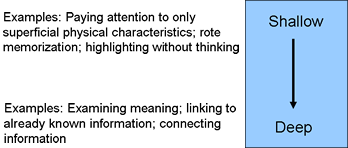
As you saw, the depth to which we process information has a huge impact on our chances of remembering it. Levels of processing (LOP) is related to encoding. The key idea is that deep, meaningful information processing lead to more permanent retention than shallow, sensory levels of processing. In general, when you process for meaning, you are processing more deeply. If you apply this to studying, you will greatly help yourself remember information!
If at some point in your undergraduate education, a professor did a cartwheel in class, do you think you'd remember that? I'm sure you would! Why? Because that would be a unique event, in other words it is distinctive.
Distinctiveness and elaboration are two factors which contribute to deeper levels of processing.
- Distinctiveness refers to how unique a stimulus is and the memory trace is. For example, I find it easier to learn the names of male students in my classes than female. Why? There are fewer males than females at OLLU, so the males' names are more distinct at first.
- Elaboration refers to how rich and complex a memory trace is. Your recall will be better for something embedded in a richer, more elaborate context. To get a better understanding of this, try the demonstration below.

Craik and Tulving showed the effect of elaboration by having research participants decide whether words fit in sentences. These sentences differed in how elaborate they were. People were better at recalling words when their task had been to determine if it fit in a more elaborate sentence, rather than a simple sentence. This is similar to what you experienced in the demonstration.

The effect of elaboration leads to some amazing feats of memory, which any of us can do! How amazing could your memory be if you use this technique? Watch as Joshua Foer shows you.
Self-Reference
What's one of the best ways to encoding information? Doing this demonstration is a great way to understand the power of the self-reference effect described in your book. It is based on the classic study by Rogers, Kuiper, and Kuiper. To do this demonstration:
- First, make sure to print out the response sheet by clicking HERE.
- Then click on the icon below to start the demonstration and follow the instructions provided. It will ask if you want to run the file. Say "yes," as it is a safe file.
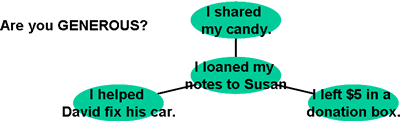
As shown by the self-reference effect, when we think about a word in connection with ourselves, we develop a particularly memorable coding for that word. Why? It ties back to the effect of elaboration. Your self-knowledge is the most elaborate body of knowledge you have. So information connected to it gets connected to a very elaborate, complex body of knowledge.
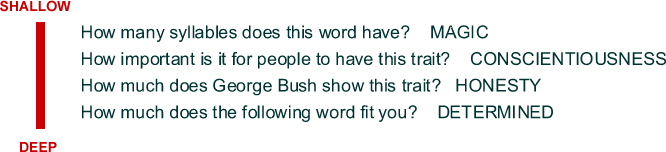
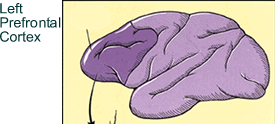
Craik used PET scans to measure brain activity while participants answered questions such as these:
|
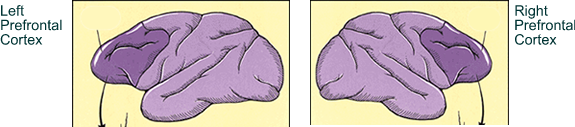
The three deeper levels of processing were associated with left prefrontal cortex activation. |
|
|
In addition to the left prefrontal cortext, the self-reference question also activated the right prefrontal cortex. |
|
Encoding Specificity
Have you ever not recognized someone outside of the situation that you usually see them in? Has a song or a smell ever brought back a rich, complete memory for you? Have you ever struggled to remember something on an exam, and you could remember what part of the page it was on, that it was near a graphic, etc? How do you think you would do on an exam if I told you the exam would be all multiple choice, but it was actually all essay questions? All of these are due to the effect of encoding specificity
Let's start with a demonstration. Follow along with the demonstration in this video. Keep track of what you are asked to.
Did you experience the effect? The encoding specificity principle reflects that retrieval is better if the context during which you retrieve memory is the same as when you encoded it. This effect is especially powerful:
- in recall rather than recognition tasks (a recall task is when you have to remember something with no prompts, while a recognition task is when you are given something (such as a photo) and asked if you recognize it)
- in real life situations more so than in lab studies
- when there is a fairly long delay between the experience and time of recall
The effect of context has also been studied in the lab environment. A couple of example studies are mentioned in the text. Below are a few of the more interesting and famous studies looking at the effect of different types of encoding-retrieval contexts. The upshot of all of these studies is that retrieval of information or experiences is best when under the same conditions as the original encoding of the material or experiences.
Physical Context
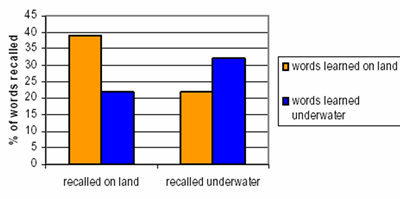
Godden and Baddeley had scuba divers study word lists on land or in water, and then had them retrieve either on land or in the water. As you can see from the graph, their recall was better when the encoding environment matched the retrieval environment (e.g., when they learned words in the water, they recalled more words when they were tested back in the water).
State Dependent Context
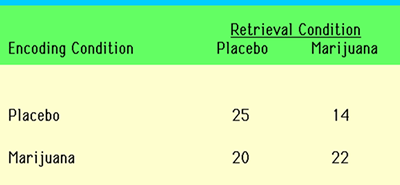
Eich and his colleagues had participants learn word under the influence of marijuana or a placebo, and then had them retrieve them in either the same or the opposite state.Recall was better when the original state at encoding matched the state at retrieval. In other words, the best recall was when participants learned words while smoking the placebo and then retrieved them with the placebo. Recall of words under the influence of marijuana was also better when they had initially studied the words while under the influence.
Emotional Context
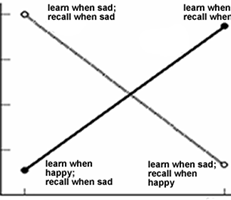
Bower's study looked at the influence of emotion. The upshot of his studies was that recall is better if we are at the same mood at time of recall as we were when we learned the material. This is summarized in the graph below.